Urgent care near me
Sane-day doctor visits
Feel better faster. Get care today.
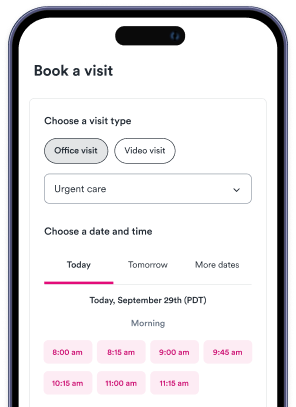
From the clinic or your couch. Find high quality, same-day urgent care for you and your kids. Book an urgent care visit today.

Yes — urgent care providers can prescribe most medications you'd reasonably need for an acute illness or injury. That includes antibiotics for a confirmed bacterial infection, antivirals for the flu, inhalers for a wheezing episode, short courses of oral steroids, anti-nausea medication, topical treatments, and many others. What urgent care generally won't do is prescribe Schedule II controlled substances like oxycodone or Adderall, manage your long-term chronic medications, or issue refills for drugs that require ongoing specialist oversight.1,2 The rules around what an urgent care can and can't write for you are driven by federal DEA scheduling, antibiotic stewardship guidance from the CDC, and the simple fact that urgent care is built for episodic care — not lifelong disease management.
Urgent care clinics are staffed by licensed clinicians — physicians (MDs, DOs), nurse practitioners (NPs), and physician assistants (PAs) — all of whom have prescriptive authority within their state's scope of practice.2 For an acute visit, that typically covers:
Three categories of medication are usually off-limits at urgent care:
The Drug Enforcement Administration (DEA) classifies drugs with the highest abuse potential as Schedule II — these include strong opioids (oxycodone, hydrocodone, morphine, fentanyl) and stimulants used for ADHD (Adderall, Ritalin, Vyvanse, Concerta).1 By federal regulation, Schedule II prescriptions cannot be refilled; each fill requires a brand-new prescription.6 Urgent care clinicians typically avoid prescribing Schedule II drugs unless there's a clear acute indication (for example, a small quantity of a low-dose opioid for severe acute pain in a setting where the clinic's policy allows it). Most urgent cares will not initiate ADHD medication, prescribe ongoing opioid therapy, or refill a chronic pain prescription.
Urgent care is designed for episodic problems. Ongoing management of diabetes, hypertension, high cholesterol, depression, anxiety, thyroid disease, and similar chronic conditions belongs with a primary care provider or specialist who can monitor labs, adjust doses over time, and coordinate care.2 An urgent care can sometimes provide a one-time bridge supply — for example, a 30-day refill of a blood pressure medication if you're traveling and ran out — but it won't take over ongoing refill management.
Drugs that require specialist supervision, REMS programs, or close monitoring — biologics, chemotherapy, isotretinoin (Accutane), buprenorphine/Suboxone (which requires a separate DEA waiver and protocol), warfarin titration, and most psychiatric medications — generally aren't started at urgent care.
Sometimes, with important caveats. For non-controlled chronic medications (like lisinopril, metformin, levothyroxine, or an albuterol inhaler), an urgent care provider can often write a short bridge prescription if you're out and can't reach your regular doctor — typically enough to last until you can get back in with your prescriber.
For controlled substances, the rules are stricter:
Even when the law allows a refill, most urgent cares will decline to refill a controlled substance they didn't originally prescribe. The reason: responsible prescribing of controlled medications requires a longitudinal patient relationship, access to your full medication history, and often a check of the state Prescription Drug Monitoring Program (PDMP).
Almost always, yes. The vast majority of U.S. clinicians use electronic prescribing (e-prescribing) for non-controlled medications, and DEA regulations have permitted electronic prescribing of controlled substances (EPCS) since 2010 — with a 2023 update that also allows pharmacies to transfer electronic Schedule II–V prescriptions between pharmacies for initial filling at the patient's request.8
What that means for you: when you check out at urgent care, your prescription is usually waiting (or being prepared) at your pharmacy by the time you arrive. Make sure to confirm with the front desk which pharmacy you'd like it sent to — including the specific location, since many chains have multiple nearby stores.
For most non-controlled medications, the prescription leaves the clinic's e-prescribing system within minutes of your visit ending. The bottleneck is usually the pharmacy queue, not the clinic. Many people can pick up their prescription within 30 to 60 minutes of leaving urgent care, though high-volume pharmacies, weekend hours, and back-ordered medications can stretch that to a few hours.
Controlled substance prescriptions can take slightly longer because some clinics still use paper for Schedule II drugs, even though EPCS is permitted. Ask before you leave whether your script was sent electronically or if you need to carry a paper prescription to the pharmacy.
A few simple things make it much easier for the urgent care provider to write the right prescription quickly:
Need a same-day prescription? Solv can help you find an urgent care nearby, often with an online booking option.
Generally no. Adderall, Vyvanse, Ritalin, and Concerta are Schedule II controlled stimulants. Most urgent cares will not initiate or refill ADHD medication because federal law prohibits refills on Schedule II prescriptions and responsible stimulant prescribing requires a longitudinal relationship with a psychiatrist, pediatrician, or primary care provider who can monitor response over time.
Usually no. Buprenorphine-based medications like Suboxone are Schedule III controlled substances used to treat opioid use disorder, and clinicians need specific training and protocols to prescribe them safely. Some urgent care networks have established addiction-treatment programs, but it's the exception. If you need help starting or continuing medication for opioid use disorder, ask the urgent care for a referral or contact SAMHSA's National Helpline.
Yes, in most cases. Albuterol rescue inhalers and most maintenance inhalers are not controlled substances, so an urgent care provider can write a prescription if you're having symptoms or simply ran out. Bring your old inhaler or a photo of the label so the provider can match the dose and device, and confirm your preferred pharmacy before leaving.
No — and that's by design. CDC and AAFP guidance is clear that azithromycin and other antibiotics should not be prescribed for viral infections like the common cold, most cases of bronchitis, the flu, or COVID-19. A responsible urgent care will only prescribe a Z-Pak when there's a likely bacterial cause, such as confirmed strep throat (if amoxicillin is contraindicated), some cases of bacterial pneumonia, or specific bacterial respiratory infections.
Not typically. Prescribing requires a clinical evaluation, which usually means an in-person or video visit with the patient. There are limited exceptions — for example, a parent or guardian visiting on behalf of a young child, or established telehealth relationships. For controlled substances, federal DEA rules require an in-person evaluation in most cases before a controlled medication can be prescribed via telehealth.
It depends on the drug schedule. Non-controlled prescriptions are typically valid for up to one year from the date written, though state laws vary. Schedule III and IV controlled substance prescriptions must be filled or refilled within 6 months of the issue date and allow a maximum of 5 refills. Schedule II prescriptions cannot be refilled at all — each fill needs a new prescription — and many states require Schedule II scripts to be filled within a shorter window after they're issued.
From the clinic or your couch. Find high quality, same-day urgent care for you and your kids. Book an urgent care visit today.

Medically reviewed
View this article's sources and history, and read more about Solv's Content Mission Statement, editorial process, and editorial team.
Solv has strict sourcing guidelines and relies on peer-reviewed studies, academic research institutions, and medical associations. We avoid using tertiary references.
Solv’s team of medical writers and experts review and update our articles when new information becomes available.
Written by Solv Editorial Team
Medically reviewed by: Dr. Rob Rohatsch, MD
Edited by Solv Editorial Team
Edited by Solv Editorial Team
Edited by Solv Editorial Team
Edited by Solv Editorial Team
From the clinic or your couch. Find high quality, same-day urgent care for you and your kids. Book an urgent care visit today.