Urgent care near me
Sane-day doctor visits
Feel better faster. Get care today.
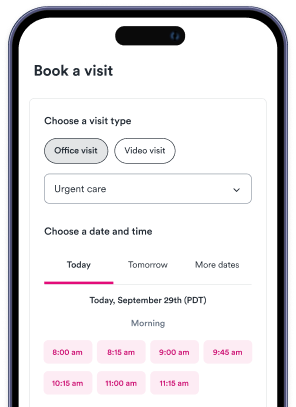
From the clinic or your couch. Find high quality, same-day urgent care for you and your kids. Book an urgent care visit today.

Joint and soft-tissue pain can be acutely debilitating, and waiting weeks for a specialist appointment isn't always realistic. If you're dealing with a swollen, inflamed tendon, a painful bursa, or a joint that's limiting your daily function, you may be wondering whether a cortisone shot is available to you at urgent care — and whether you even need to go anywhere else. The short answer is yes, many urgent care centers do provide corticosteroid injections for appropriate conditions. Here's what you need to know about who can get one, what to expect, and when a specialist is the better choice.
Cortisone is a corticosteroid — a class of anti-inflammatory medications that mimic the action of cortisol, a hormone produced naturally by the adrenal glands. When injected directly into an inflamed area, corticosteroids suppress the local inflammatory response by inhibiting the production of inflammatory chemicals (cytokines and prostaglandins) and reducing the accumulation of immune cells in the tissue.
The result is a significant reduction in pain, swelling, and stiffness in most patients. Unlike oral anti-inflammatory medications that affect the whole body, an injected corticosteroid acts locally, which means the dose needed is smaller and the systemic side effects are less pronounced. Common agents used for injection include triamcinolone acetonide, methylprednisolone acetate, and betamethasone, often mixed with a local anesthetic like lidocaine to provide immediate temporary relief while the steroid takes effect.
Urgent care providers are well-suited to evaluate and inject a range of soft-tissue and joint conditions that don't require imaging guidance for safe needle placement. The most common conditions treated with cortisone shots at urgent care include:
For all of these, the anatomy is accessible and the injection site can be located accurately based on physical examination and surface landmarks alone. No imaging is required for a trained provider to administer the shot safely and effectively.
There are cortisone injection procedures that go beyond the scope of urgent care and require specialist involvement or imaging guidance. These include epidural steroid injections for radiculopathy or spinal stenosis, facet joint injections for back pain, ultrasound-guided injections for small joints or tendons where surface landmarks are unreliable, and injections into joints that have been replaced with prosthetics, which carry infection risks that require orthopedic oversight.
If your pain stems from a compressed nerve root, a torn rotator cuff that needs surgical evaluation, or a complex joint condition requiring an MRI before management decisions are made, urgent care will typically refer you appropriately rather than proceed with an injection. This is the right call — a cortisone shot given without knowing the full picture of what's causing your pain can delay the correct diagnosis.
Before administering a cortisone shot, your provider will take a brief history of your symptoms — how long you've had the pain, what makes it better or worse, what treatments you've already tried, and whether you have any conditions that might affect safety (such as diabetes, a history of steroid sensitivity, or an active skin infection near the injection site).
The injection itself takes only a few minutes. The area is cleaned with antiseptic, and the provider inserts a needle into the target area — typically into the bursa, tendon sheath, or joint space. Many providers mix the corticosteroid with a local anesthetic such as lidocaine, which produces near-immediate (if temporary) pain relief and helps confirm the needle is in the right place. Most patients describe the injection as a brief pressure or mild stinging sensation.
In the 24–48 hours after the shot, it's common to feel a temporary increase in soreness at the injection site — sometimes called a "steroid flare." This is a normal inflammatory response to the injected crystals and resolves on its own. Applying ice and taking over-the-counter pain relievers during this window is appropriate. Full anti-inflammatory benefit from the corticosteroid typically sets in within 3–7 days.
Cortisone shots are not a treatment you can use indefinitely or repeatedly without consequence. Research consistently shows that repeated corticosteroid injections into the same location can lead to tendon weakening, cartilage thinning, and in some cases, accelerated joint deterioration. The American Academy of Family Physicians and orthopedic specialty societies generally recommend limiting injections to a single site to no more than three or four times per year.
This frequency limit exists partly because of the physical effects of the steroid on connective tissue, and partly because pain that requires that many injections likely has an underlying cause that hasn't been fully addressed. If you've had three cortisone shots in the same location and are still in significant pain, the next step is usually imaging and specialist referral — not a fourth injection.
People with diabetes should be aware that corticosteroid injections can cause a temporary spike in blood glucose, sometimes lasting several days. This is typically manageable but warrants monitoring and, in some cases, proactive communication with your endocrinologist or primary care provider.
If you're experiencing joint or tendon pain that is limiting your movement or daily function, urgent care can be a practical first stop for same-day evaluation. Before making the trip, it's worth calling the clinic to confirm that a provider who performs injections is available — not all urgent care providers are trained in musculoskeletal injections, and availability varies by location and staffing. If injections are offered, the provider can assess whether a cortisone shot is appropriate, administer it if indicated, and refer you to a specialist if imaging or more advanced care is needed.
Urgent care providers commonly give cortisone injections for shoulder bursitis, tennis elbow (lateral epicondylitis), trigger finger, De Quervain's tenosynovitis, and localized joint inflammation in accessible joints like the knee or ankle. More complex injections — like epidural steroid injections for back pain — are done by specialists.
You may feel some soreness at the injection site for 24–48 hours after the shot. Most patients notice significant pain relief within 3–7 days as the inflammation subsides. If you haven't felt any improvement after two weeks, follow up with your provider.
For most people, cortisone shots are safe and well-tolerated. Risks include temporary blood sugar elevation (significant for diabetics), skin thinning at the injection site with repeated shots, and rarely, infection. Your provider will assess whether you're a good candidate before administering.
Most guidelines recommend limiting cortisone shots to the same location to 3 or 4 times per year. More frequent injections can weaken tendons and potentially damage cartilage over time.
No. You can walk into urgent care and request evaluation for a cortisone injection. The provider will assess your condition and determine if an injection is appropriate, or if you'd benefit more from imaging or a specialist referral first.
From the clinic or your couch. Find high quality, same-day urgent care for you and your kids. Book an urgent care visit today.

Dr. Linda Halbrook is a Board-Certified Family Medicine physician with over 40 years of experience, dedicated to providing comprehensive care to patients across Texas. She retired from practice but currently serves on the Clinical Services Committee of CommonGood Medical, a non-profit organization serving the uninsured in Collin County.
Medically reviewed
View this article's sources and history, and read more about Solv's Content Mission Statement, editorial process, and editorial team.
Solv has strict sourcing guidelines and relies on peer-reviewed studies, academic research institutions, and medical associations. We avoid using tertiary references.
Solv’s team of medical writers and experts review and update our articles when new information becomes available.
Written by Solv Editorial Team
Medically reviewed by: Dr. Rob Rohatsch, MD
Edited by Solv Editorial Team
From the clinic or your couch. Find high quality, same-day urgent care for you and your kids. Book an urgent care visit today.