Urgent care near me
Sane-day doctor visits
Feel better faster. Get care today.
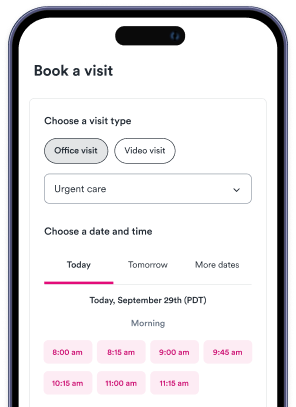
From the clinic or your couch. Find high quality, same-day urgent care for you and your kids. Book an urgent care visit today.
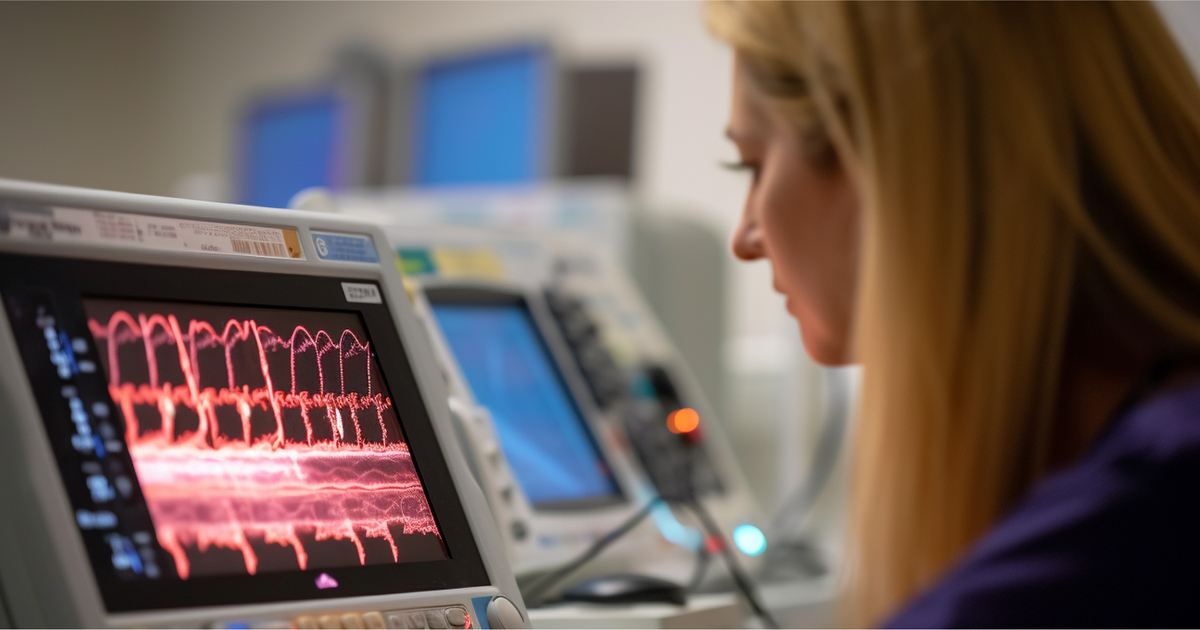
Yes — many urgent care clinics can perform a 12-lead electrocardiogram (EKG or ECG) on site. The test takes about five minutes, is painless, and helps a provider rule out or detect heart rhythm problems, signs of a heart attack, and other cardiac issues. If your symptoms are high-risk for acute coronary syndrome, however, the right place to go is the emergency room, not urgent care.1,2
An electrocardiogram is a recording of the electrical signals that drive each heartbeat. Small adhesive electrodes are placed on the chest, arms, and legs. A machine captures 12 different "views" of the heart's electrical activity over about 10 seconds and prints (or displays) a tracing for the provider to interpret.3
An EKG can help identify:
• Abnormal rhythms (atrial fibrillation, supraventricular tachycardia, bradycardia)
• Signs of an ongoing or recent heart attack — ST elevation, new bundle branch block, new Q waves, T-wave inversions
• Signs of chamber enlargement, electrolyte imbalances, and certain congenital conditions1,3
Yes. The 2021 AHA/ACC chest pain guideline states that for outpatient settings — which includes urgent care — a 12-lead EKG should be obtained promptly for patients with chest discomfort or other concerning cardiac symptoms.1 Many urgent care clinics have EKG machines and trained staff to perform and interpret the tracing.
Typical urgent care workflow:
• Provider takes a focused history and exam, including risk factors for heart disease
• An EKG is performed and reviewed within minutes
• Based on the EKG and clinical picture, you may be sent home with reassurance and outpatient follow-up, referred to a cardiologist, or sent to the ER1,2
The AHA/ACC guideline is clear: any patient with active, severe, or "red-flag" chest pain belongs in the emergency department, not urgent care. Red-flag features include:1,2
• Sudden, severe chest pain or pressure, especially if it spreads to the arm, jaw, neck, or back
• Chest pain with shortness of breath, sweating, nausea, or vomiting
• Chest pain at rest or lasting more than 10 minutes
• Fainting or near-fainting with the episode
• Known coronary artery disease, prior heart attack, or recent stent
Urgent care can be appropriate when symptoms are mild, intermittent, or clearly non-cardiac in flavor — for example, brief palpitations during exercise, a sense of skipped beats, or mild lightheadedness — and you cannot quickly reach your primary care provider.1
An EKG is painless. A medical assistant or nurse will:
• Ask you to remove clothing above the waist and put on a gown for chest access
• Clean the skin and place 10 small sticky electrodes on the chest, arms, and legs
• Ask you to lie still and breathe normally for 10 seconds
• Remove the electrodes — they may leave a faint sticky residue that washes off easily3
The entire process — setup, recording, and provider review — usually takes 5 to 10 minutes.
A normal urgent care EKG does not rule out heart disease. The EKG is a snapshot — it shows only what is happening in the few seconds during recording. Important conditions that may not show up on a single EKG include:
• Intermittent rhythm problems that have already stopped by the time the test is run
• Stable coronary artery disease without an active heart attack
• Some heart attacks that affect only the back of the heart, which a standard 12-lead may not capture1,3
For these reasons, providers combine the EKG with the patient's symptoms, vital signs, exam, and (in the ER) high-sensitivity troponin blood testing to rule out a heart attack.1,2
An abnormal EKG does not automatically mean a heart attack. Many people have findings that are normal for them or stable over time. Your provider will:
• Compare the EKG with any prior tracing on file
• Look for findings that suggest a cardiac emergency (such as ST elevation)
• Decide whether to refer you to the ER for further workup, to schedule cardiology follow-up, or to manage you in clinic with medication adjustments
If the urgent care team suspects acute coronary syndrome, the standard of care is immediate transport to an emergency department, ideally by ambulance.1,2
To make the visit faster and more useful for your provider:
• Wear a top that is easy to remove or unbutton
• Bring a current list of medications and dosages
• Note when your symptoms started, how long they lasted, and what you were doing at the time
• Bring any prior EKG tracings or cardiology records if you have them
• Avoid heavy lotions or oils on your chest the day of the test, since they can interfere with electrode adhesion
If you have new chest discomfort, palpitations, or unexplained lightheadedness — but no red-flag symptoms — find an urgent care or same-day clinic on Solv that offers EKG testing. For severe or sudden chest pain, call 911 or go directly to the nearest emergency room.
The recording itself takes only about 10 seconds. With setup, the actual test usually takes 5 to 10 minutes. Adding the provider visit and review, the whole appointment is typically 30 to 45 minutes, depending on clinic volume.3
Cash-pay EKG charges typically range from about $50 to $150, separate from the visit fee. Most commercial insurance plans, Medicare, and Medicaid cover medically necessary EKGs. Confirm coverage and any co-pay with your plan before the visit when possible.
A 12-lead EKG can show clear evidence of a STEMI (a type of heart attack) that requires immediate ER transfer. It cannot fully rule out a heart attack on its own — only ER-level troponin blood testing combined with serial EKGs can do that.1,2
Yes — if the urgent care provider sees findings consistent with acute coronary syndrome or an unstable rhythm, the standard of care is immediate transfer by ambulance. You should not drive yourself to the ER in that situation.1
Not required, but very helpful. Some EKG abnormalities are old or chronic and look the same as years ago — comparing to a prior tracing helps the provider decide whether a finding is new or stable. Bring or have your prior records sent if you can.1
Most urgent care centers do not offer stress tests or echocardiograms — those usually require cardiologist supervision and are scheduled at a cardiology office, hospital, or imaging center. If urgent care suspects you need one, they will refer you for follow-up.1,2
From the clinic or your couch. Find high quality, same-day urgent care for you and your kids. Book an urgent care visit today.

Medically reviewed
View this article's sources and history, and read more about Solv's Content Mission Statement, editorial process, and editorial team.
Solv has strict sourcing guidelines and relies on peer-reviewed studies, academic research institutions, and medical associations. We avoid using tertiary references.
Solv’s team of medical writers and experts review and update our articles when new information becomes available.
Written by Solv Editorial Team
Medically reviewed by: Dr. Rob Rohatsch, MD
Edited by Solv Editorial Team
Edited by Solv Editorial Team
Edited by Solv Editorial Team
Edited by Solv Editorial Team
Edited by Solv Editorial Team
Edited by Solv Editorial Team
Edited by Solv Editorial Team
From the clinic or your couch. Find high quality, same-day urgent care for you and your kids. Book an urgent care visit today.