Urgent care near me
Wegovy pill from $149/month
The FDA-approved weight loss pill is here
No injections. Just once-daily Wegovy® with proven results—up to 17% average weight loss in trials.
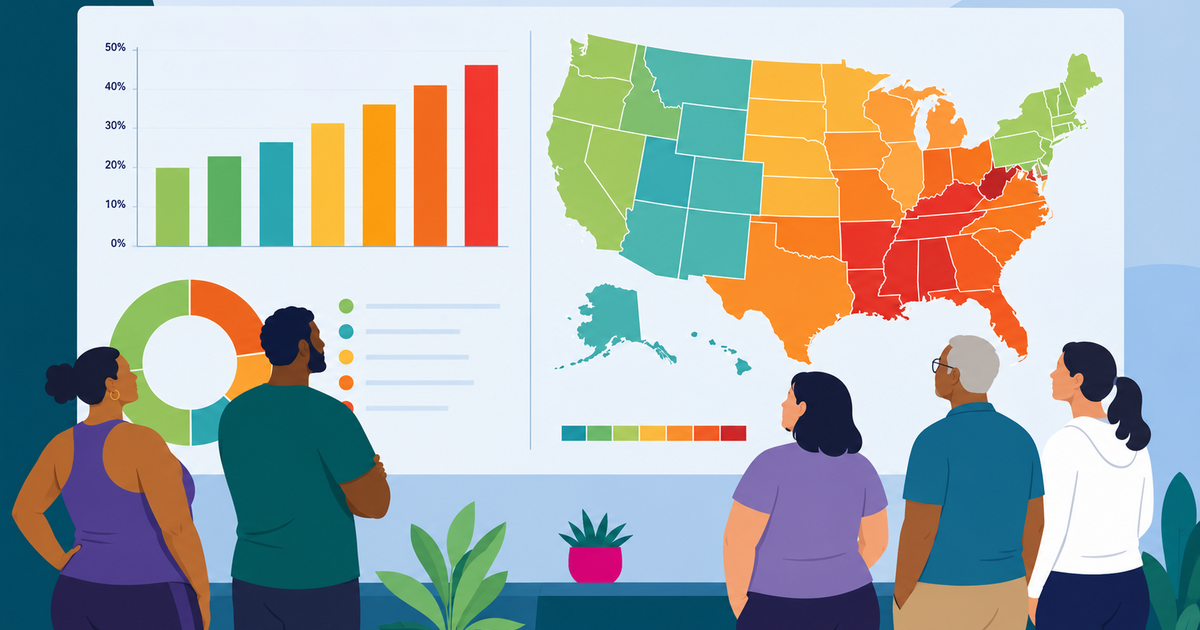
Obesity statistics in 2026 show a complex picture: adult rates in the United States remain high, childhood trends are worrisome, and new treatments (like GLP-1 medicines) are changing care options — though not yet the overall curve. Below, we break down the latest numbers, who’s most affected, why obesity happens, how GLP-1s fit in, and the health risks to know — so you can make confident choices for your family’s care.
Obesity means too much body fat in a way that harms health. For adults, clinicians screen with body mass index (BMI): a BMI ≥30 is obesity, ≥40 is severe obesity. For kids and teens, BMI is compared with age- and sex-specific growth charts; obesity is a BMI at or above the 95th percentile. Waist measures can add context, especially for central (abdominal) fat. These definitions come from the World Health Organization (WHO).
Bottom line: More than 4 in 10 U.S. adults have obesity, and nearly 1 in 10 have severe obesity.
Overall prevalence: 40.3% of U.S. adults had obesity in the most recent National Health and Nutrition Examination Survey (NHANES) cycle (Aug 2021–Aug 2023). Women (41.3%) and men (39.2%) were similar. Severe obesity affected 9.4% of adults. Compared with 2013–2014, overall obesity hasn’t significantly increased, but severe obesity did rise (about 20% relative increase). These are CDC/NCHS estimates.
By state: Obesity is common nationwide. CDC’s state maps show many states with adult obesity prevalence ≥35%. Trust for America’s Health (TFAH) reports 23 states at or above 35%, with West Virginia at the top (~41%) and Washington, D.C. the lowest (~24–25%).
Trend watch: The latest CDC map release (2024 data) did not show a broad decline from the prior year — reinforcing that population-level rates remain elevated.
Regional/state variation: Highest rates cluster in parts of the South and Midwest; lower rates are more common in some Western and Northeastern jurisdictions. (See CDC’s interactive maps for your state.)
Short answer: About 1 in 6 U.S. kids ages 6–17 have obesity, and roughly 1 in 5 U.S. adolescents do.
Children 6–17 (U.S.): 16.1% had obesity in 2023–2024, based on National Survey of Children’s Health (NSCH) analyses.
Adolescents 12–17 (U.S.): About 21% have obesity, according to a 2024 review in JAMA.
Global context: WHO notes that worldwide, 16% of adults had obesity in 2022, and adolescent obesity has quadrupled since 1990. UNICEF’s 2025 Child Nutrition Report found a turning point: among 5–19-year-olds, global obesity (9.4%) surpassed underweight (9.2%) for the first time.
Age. Middle age carries the highest risk. In 2021–2023 NHANES data, obesity prevalence was 46.4% among adults 40–59, compared with 35.5% for ages 20–39 and 38.9% for 60+. Severe obesity (BMI ≥40) was 12.0% at ages 40–59, 9.5% at 20–39, and 6.6% at 60+. Women had higher severe obesity than men overall (12.1% vs. 6.7%). These estimates are based on measured height and weight.
Education. There’s a clear gradient: adults with a bachelor’s degree or higher had 31.6% obesity vs. 44.6% with a high school diploma or less and 45.0% with some college.
Race and ethnicity. BRFSS maps (2022–2024 combined) show the number of states/territories where obesity was ≥35% within each group: Black adults (41 areas), American Indian/Alaska Native adults (36), Hispanic adults (33), White adults (17), and Asian adults (0).
Region and state. In 2024, obesity prevalence was highest in the Midwest (35.9%) and South (34.5%), followed by the Northeast (30.3%) and West (30.2%). Mississippi and West Virginia, plus Guam, were at ≥40%.
Rural vs. urban. Earlier BRFSS analyses still illustrate a persistent gap: in 2016, obesity prevalence was 34.2% in nonmetropolitan vs. 28.7% in metropolitan counties, reflecting differences in food/physical activity environments.
Disability. Adults with disabilities have substantially higher rates — 40.5% vs. 30.3% without disabilities — alongside higher burdens of heart disease and diabetes.
Overall prevalence. About 16.1% of U.S. children ages 6–17 have obesity (NSCH 2022–2023).
Race and ethnicity. NSCH shows non-Hispanic Black (23.5%) and Hispanic (22.2%) youth have the highest prevalence; non-Hispanic Asian (10.6%) the lowest; non-Hispanic White (13.2%) in between.
Household income. A strong gradient appears in childhood: 24.1% of children below poverty have obesity versus 10.4% of those at ≥400% of the federal poverty level.
States with highest youth rates. Seven states are significantly above the national 16.1%: MS, WV, LA, AL, AR, TX, TN.
Global context. UNICEF’s 2025 Child Nutrition Report notes that, for the first time, the global prevalence of obesity among ages 5–19 (9.4%) now exceeds underweight (9.2%), underscoring the role of unhealthy food environments.
Short answer: biology collides with environment. Clinicians increasingly frame obesity as a chronic, relapsing disease where genetic and hormonal defenses of body weight meet food, activity, sleep, stress, medications, and broader social conditions.
Biology and genetics. Weight is influenced by genes and neurohormonal pathways that defend against weight loss. NIDDK highlights genetics, medical conditions, and medicines among contributors.
Medications that promote weight gain. Some antidepressants, antipsychotics, corticosteroids, diabetes drugs (insulin/sulfonylureas), and others can increase appetite or alter metabolism. (Talk with a clinician before changing any medication.)
Food environment and ultra-processed foods (UPFs). In a tightly controlled NIH inpatient crossover RCT, adults ate ~500 extra calories/day and gained weight on an ultra-processed diet — even when calories, sugar, fat, sodium, fiber, and macros were matched to an unprocessed diet. That’s causal evidence that food processing can drive higher intake.
Sugary drinks. CDC emphasizes that sugar-sweetened beverages add a lot of “invisible” calories and are linked with weight gain, obesity, type 2 diabetes, heart disease, cavities, and gout.
Physical activity and built environment. Opportunities (or barriers) for daily movement — walkable streets, safe parks, time and transportation — matter. Rural residents face higher obesity in part due to limited access to places to be active and healthy foods.
Sleep, stress, and sedentary time. Short sleep, chronic stress, and lots of sitting (including screen time) are associated with weight gain through appetite and metabolic changes.
Social determinants. Income, education, housing, and neighborhood resources shape access to affordable, nutritious food and safe activity — key reasons we see disparities by education and poverty.
GLP-1–based medicines are powerful tools for individuals, but it’s too early to see population-level declines in U.S. obesity rates.
How effective are they? In STEP-1, once-weekly semaglutide 2.4 mg produced ~15% average weight loss at 68 weeks (vs. ~2% with lifestyle alone).
Heart protection matters. In people with overweight/obesity and established cardiovascular disease without diabetes, semaglutide reduced major adverse cardiovascular events by 20% (HR 0.80) in the SELECT outcomes trial.
Guideline momentum. WHO issued its first global guideline (Dec 2025) on GLP-1 therapies for adult obesity, positioning them within comprehensive, long-term obesity care.
Access and coverage are evolving. Coverage policies (including Medicare pathways tied to cardiovascular risk reduction) and cost may limit broad uptake today. As access expands, medications could influence future trends, but current national surveillance (NHANES/BRFSS) still shows high overall prevalence and rising severe obesity.
Direct answer: Obesity raises the risk of type 2 diabetes, high blood pressure, heart disease, stroke, sleep apnea, osteoarthritis, fatty liver disease, kidney disease, depression, and several cancers — and it can reduce quality of life.
CDC lists increased risks for diabetes, hypertension, dyslipidemia, coronary heart disease, stroke, osteoarthritis, sleep apnea, many cancers, and mental health concerns.
NIDDK similarly points to joint problems, gallstones, nonalcoholic fatty liver disease, and breathing problems.
In adolescents, obesity is tied to insulin resistance, hypertension, dyslipidemia, sleep disorders, depression, and musculoskeletal problems — and to higher adult mortality from type 2 diabetes and cardiovascular disease.
WHO underscores the global toll of high BMI on noncommunicable disease and the large economic burden (estimated to reach $3 trillion annually by 2030 and $18 trillion by 2060 if trends continue).
Start with screening and a plan.
Know your numbers: Ask your clinician to review BMI, waist measurement, blood pressure, A1C (for diabetes risk), cholesterol, and sleep apnea symptoms. (These help identify cardiometabolic risk even if BMI seems borderline.)
Lifestyle foundations: Emphasize fruits, vegetables, legumes, whole grains, lean proteins; limit sugar-sweetened beverages and ultra-processed foods; aim for 150 minutes of weekly activity (adults) or 60 minutes daily (kids); and target 7–9 hours of quality sleep (adults).
Medications and procedures: If lifestyle changes aren’t enough, ask about evidence-based medicines (including GLP-1s) or, for severe obesity, metabolic/bariatric surgery — all within comprehensive, long-term care. WHO’s 2025 guidance supports integrating medications when appropriate.
Get the right support quickly: You can use Solv to find nearby primary care, pediatric care, or telemedicine visits to discuss screening, nutrition, sleep, mental health, and weight-management options that fit your family’s needs.
40.3% of U.S. adults had obesity in 2021–2023 (measured). Men 39.2%, women 41.3%.
9.4% of adults had severe obesity; women 12.1%, men 6.7%.
Adult obesity by age: 35.5% (20–39), 46.4% (40–59), 38.9% (60+). Severe obesity: 9.5%, 12.0%, 6.6%, respectively.
Adult obesity by education: 44.6% (HS or less), 45.0% (some college), 31.6% (bachelor’s+).
Regional picture (BRFSS 2024): Midwest 35.9%, South 34.5%, Northeast 30.3%, West 30.2%.
States at ≥40%: Mississippi, West Virginia (and Guam). All states/territories are ≥25%.
By race/ethnicity (count of areas ≥35%, 2022–2024): Black 41, AI/AN 36, Hispanic 33, White 17, Asian 0.
Rural vs. urban: 34.2% nonmetropolitan vs. 28.7% metropolitan adults with obesity (2016 BRFSS analysis).
Disability: 40.5% of adults with disabilities have obesity vs. 30.3% without.
Youth (6–17): 16.1% have obesity (NSCH 2022–2023).
Youth by race/ethnicity: Black 23.5%, Hispanic 22.2%, White 13.2%, Asian 10.6%.
Youth by family income: 24.1% (below poverty) vs. 10.4% (≥400% FPL).
Global backdrop: In 2022, 16% of adults worldwide had obesity; overweight was 43%. Projected global economic costs of overweight/obesity: $3T/year by 2030 and >$18T by 2060.
Health risks (adults). Obesity raises risk of type 2 diabetes, hypertension, coronary heart disease, stroke, dyslipidemia, sleep apnea, osteoarthritis, many cancers, depression, and lower quality of life.
Health risks (youth). Childhood obesity is linked to hypertension, insulin resistance/dyslipidemia, sleep problems, depression, and higher odds of adult obesity and cardiometabolic disease.
Ultra-processed foods (mechanism). In an NIH inpatient RCT, UPFs caused ~500 kcal/day higher intake and weight gain vs. unprocessed diets, despite matched nutrients.
Sugary drinks. Leading source of added sugars; frequent intake is linked with weight gain, obesity, type 2 diabetes, and heart disease.
GLP-1 effectiveness. Semaglutide 2.4 mg led to ~15% average weight loss at 68 weeks; GLP-1s now feature in WHO’s 2025 global guidance for adult obesity care.
Cardiovascular outcomes. Semaglutide reduced major cardiovascular events by 20% in adults with overweight/obesity and established CVD, even without diabetes.
For people looking to act on this data, our guide to the best diets of 2026 covers what the current evidence actually supports.
The research on how to lose body fat sustainably points to a few consistent themes—caloric deficit, protein intake, and resistance training.
As of 2026, more than 4 in 10 U.S. adults have obesity, and nearly 1 in 10 have severe obesity. The overall prevalence is 40.3% of U.S. adults, with similar rates in women (41.3%) and men (39.2%). Severe obesity affects 9.4% of adults.
About 1 in 6 U.S. kids ages 6–17 have obesity, and roughly 1 in 5 U.S. adolescents do. The prevalence of obesity in children aged 6-17 was 16.1% in 2023-2024, and about 21% of adolescents aged 12-17 have obesity.
Obesity is a complex condition influenced by a combination of factors. These include genetics and biology, certain medications, the food environment and consumption of ultra-processed foods and sugary drinks, physical activity levels and the built environment, sleep, stress, and sedentary time, and social determinants such as income, education, housing, and neighborhood resources.
GLP-1–based medicines are powerful tools for individuals, but it’s too early to see population-level declines in U.S. obesity rates. These medications have shown effectiveness in clinical trials, with one study showing an average weight loss of around 15% at 68 weeks with the use of semaglutide 2.4 mg.
Obesity raises the risk of several health conditions, including type 2 diabetes, high blood pressure, heart disease, stroke, sleep apnea, osteoarthritis, fatty liver disease, kidney disease, depression, and several types of cancer. It can also reduce quality of life.
No injections. Just once-daily Wegovy® with proven results—up to 17% average weight loss in trials.

Dr. Linda Halbrook is a Board-Certified Family Medicine physician with over 40 years of experience, dedicated to providing comprehensive care to patients across Texas. She retired from practice but currently serves on the Clinical Services Committee of CommonGood Medical, a non-profit organization serving the uninsured in Collin County.
Medically reviewed
View this article's sources and history, and read more about Solv's Content Mission Statement, editorial process, and editorial team.
Solv has strict sourcing guidelines and relies on peer-reviewed studies, academic research institutions, and medical associations. We avoid using tertiary references.
Solv’s team of medical writers and experts review and update our articles when new information becomes available.
Written by Solv Editorial Team
Medically reviewed by: Dr. Rob Rohatsch, MD
Edited by Solv Editorial Team
Edited by Solv Editorial Team
Edited by Solv Editorial Team
Edited by Solv Editorial Team
Edited by Solv Editorial Team
No injections. Just once-daily Wegovy® with proven results—up to 17% average weight loss in trials.